.png)
.png)
.png)
The Montessori curriculum is focused on the core subjects of Sensorial, Math, Science, Cultural, and Language. In addressing the whole child, the educational experience extends the child's learning to include cooperation, contribution, strong interpersonal skills, and leadership.
The curriculum incorporates concrete materials to enable students to use all senses to understand concepts and it builds upon itself year over year. At Montessori Private Academy, we also incorporate Spanish, Physical Education, Music, and other arts.
.png)
Toddler
Age 2
.png)
Early Childhood
Pre-K to Kindergarten

Elementary I & II
Grades 1-3 and Grades 4-6
Middle School
Grades 7-8
.png)
Our Toddler program creates a nurturing environment where 2 to 3 year-olds can explore their natural desire for independence.
Grounded in Montessori principles, our curriculum supports the physical, cognitive, social, and emotional development of each child during this critical stage of growth.
Children have access to a carefully curated collection of enriching Montessori materials within a consistent, creative space. Our Montessori-trained teachers are specialists in understanding the unique developmental needs of toddlers, creating an environment where exploration, discovery, and growth flourish.
Our Early Childhood classrooms bring together mixed-age groups of children from ages 3 to 6, creating a vibrant learning community where curiosity thrives.
In our classrooms, children are free to move about and select their own work from carefully prepared materials. Before engaging with any new material, children are introduced to it; either by a teacher or by a more experienced peer. This peer mentoring is a cornerstone of our approach, allowing younger students to learn from older classmates while building community and confidence.
All materials, known as "works" in the Montessori tradition, are organized into five distinct areas of learning: Language, Math, Sensorial, Practical Life, and Culture. Each area is thoughtfully designed to support the child's natural development and growing independence.
Beyond these core learning areas, we enrich our Early Childhood program with specialized instruction in Culture, Spanish, Music, Art, and Physical Education. These enrichment experiences deepen children's engagement with the world around them and foster a love of learning across multiple disciplines.
.png)
.png)
Elementary I students enter a new phase of wonder and discovery. They're eager to understand the world around them: how people live, how things work, and where they fit into it all. At this stage, children begin grappling with bigger concepts like rules, accountability, and emotions, developing a deeper awareness of themselves and others.
Academically, students build a strong foundation in reading, writing, and mathematics while exploring language, science, and cultural studies. Through hands-on materials and guided inquiry, children develop critical thinking skills and begin to see connections between different areas of knowledge. Our curriculum emphasizes mastery of fundamental skills while nurturing a genuine love of learning.
In our classroom, students start to recognize that their actions have real consequences: that what they do impacts their classmates, their community, and the world beyond. This is a pivotal moment when children begin to see themselves not as individuals alone, but as valued members of a larger group. They're developing a sense of responsibility and discovering their unique role within our school community and the world at large.
Elementary II students are now prepared to tackle more complex issues and abstract concepts.
Their increasing competence and maturity make them ready for new social and academic advancement opportunities. Students examine current events and delve more deeply into issues requiring conflict resolution skills, problem-solving, and effective communication skills. Elementary II students continue to benefit from a wealth of hands-on materials even as they move into their ability to understand abstraction. Since they move from the concrete to the abstract at their own pace, some students are learning algebra while others are still mastering pre-algebraic concepts
The Elementary II classroom environment provides a variety of resources and learning materials. Students reference books, web searches, and a variety of Montessori materials and resources in their daily learning to master grammar, geography, and other subjects.
.png)
.png)
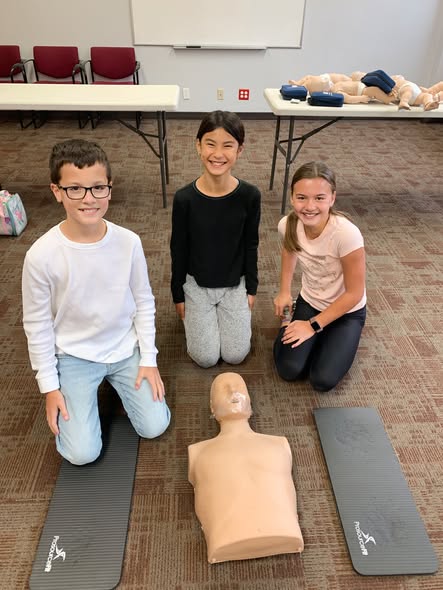
Middle School students are undergoing a profound developmental transformation, moving from the childhood years into early adolescence. They are now prepared to tackle complex societal issues, ethical dilemmas, and highly abstract concepts. Their increasing competence, budding independence, and social maturity make them ready for unique real-world responsibilities and advanced academic opportunities.
Rather than just studying topics in isolation, students examine global current events, engage in meaningful community work, and delve deeply into the interpersonal issues that require advanced conflict resolution, collaborative problem-solving, and sophisticated communication skills.While Montessori adolescents are increasingly capable of abstract thought, they still benefit from a hands-on approach to learning. At this stage, the materials often transform into real world projects, micro-economies, and laboratory experiments.
Because students move from the concrete to the abstract at their own unique pace. This deeply individualized approach honors each student's developmental timeline, allowing them to balance rigorous academic pursuits with their emotional, social, and physical growth